
Places / Landscapes & attention
Somewhere, without
the hurry.
The most memorable places are not always the ones with a pin on a map. They are often a change in the path, a sheltered edge of water or a familiar walk seen in different light.
The shore between seasons
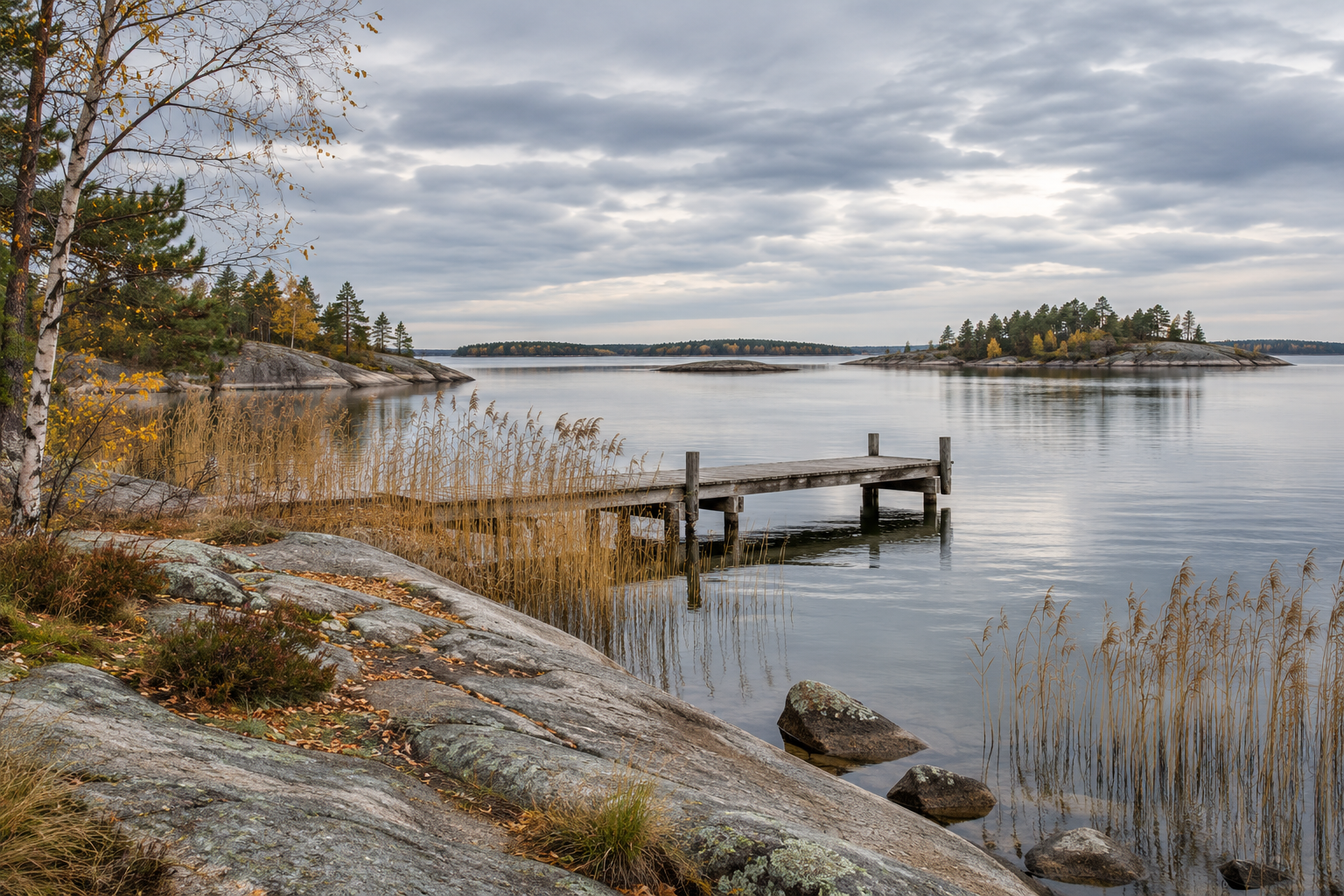
A northern shoreline asks you to change your sense of scale.
At first there is only the wide view: low islands, a pale horizon, a band of dark water. Then the smaller things begin to appear. Rain has gathered in a shallow seam in the granite. A reed bends in a direction the wind has already left behind. The line between land and water is not a line at all, but a patient exchange.
We tend to imagine the coast in summer. Light arrives early, the water holds a promise, and every flat rock looks like a place to sit. The quieter months offer something different. With fewer distractions, the structure of the landscape becomes easier to read: the shelter of a bay, the angle of a roof, the point where trees stop growing upright and begin negotiating with the weather.
There is no need to turn that attention into a checklist. A short walk and an unhurried pause are enough. Choose a public path, keep a respectful distance from homes and working shores, and allow the weather to decide how long you stay. The reward is not a spectacular photograph. It is a clearer feeling for where you are.
A path through the pines
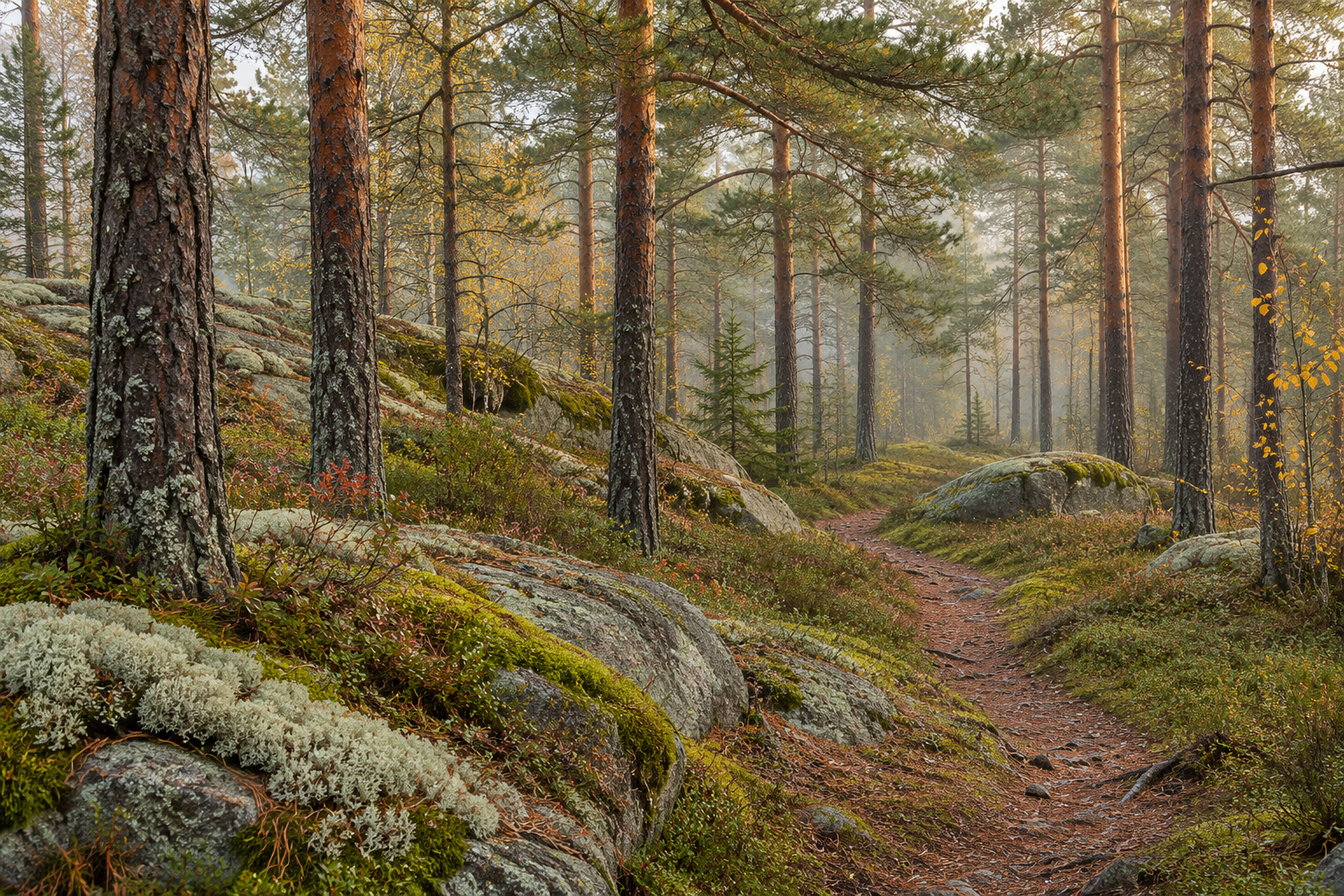
A woodland path is an accumulation of ordinary decisions. Someone stepped around a wet patch. Someone else followed. Over time, a route became visible without ever becoming entirely fixed. Looking down reveals this shared history as clearly as looking ahead.
In a pine forest, the surface is rarely one thing. Needles collect between stones; roots cross a soft hollow; lichen makes a pale island on a boulder. Each surface has its own pace. Walking slowly is not an exercise in making a short route last longer. It is a way of avoiding the assumption that all ground is interchangeable.
The same care applies to sound. A conversation carries farther than expected when the air is still. A bird changes position before you have noticed it. The forest is not an empty room provided for our experience. It is already occupied, and a good walk begins with remembering that.
Follow the path, but keep some attention for everything that does not follow it.
The care in a place
A landscape becomes welcoming through small acts of care: a boardwalk kept in repair, a gate closed behind a walker, a bench that does not block the view. These are not dramatic interventions. They are agreements about how to share space without wearing it out.
When visiting an unfamiliar place, practical information matters more than romantic ideas about freedom. Read local signs, use established routes where requested, take litter away and check restrictions before lighting a fire or staying overnight. Seasons, protected areas and local conditions change what is appropriate. A beautiful view is never a reason to disregard a clear boundary.
We write about places to encourage attention, not to send a crowd toward a hidden coordinate. The settings in our illustrations are imagined. The habits of observation and care are useful wherever a path begins.
A small field notebook
Before you leave, notice one texture, one sound and one change in the light. Write them down in plain words. You may remember more than a photograph could hold.